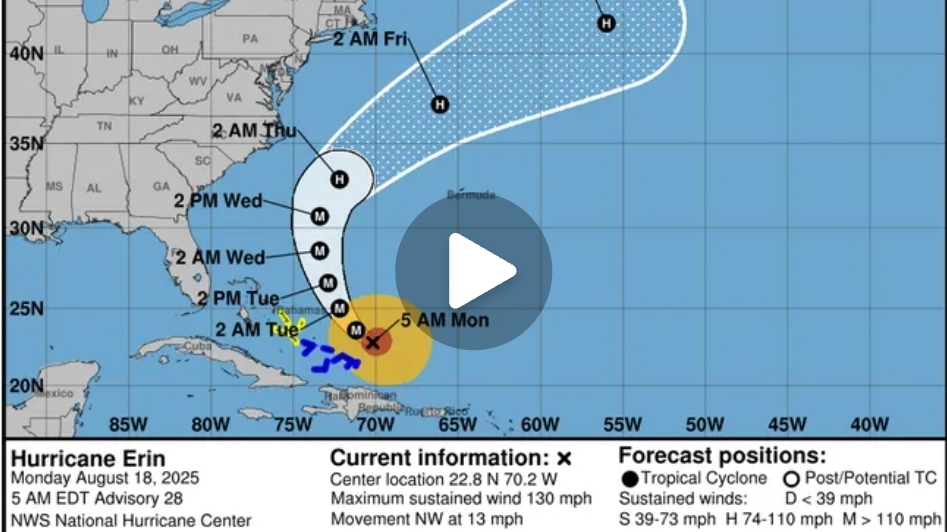
Snapshot: What’s Happening with Hurricane Erin
Current Status: Hurricane Erin has re-intensified into a Category 4 storm. It now boasts sustained winds of roughly 130 mph (215 km/h). This follows a previous peak as a Category 5 with winds reaching 160 mph.
Location & Movement: As of today, Erin sits about 105 miles north-northeast of Grand Turk Island, moving northwest at around 13 mph (20 km/h).
Size & Impact Radius:
Hurricane-force winds now extend about 60 miles from the center.
Tropical-storm-force winds stretch out to 230 miles.
The wind field has expanded dramatically, influencing seas hundreds of miles from the eye.
Threats & Watches:
Tropical Storm Warnings/Watching: In effect for Turks and Caicos, southeastern and central Bahamas.
Evacuations & Alerts:
Dare County, North Carolina declared emergencies and issued evacuation orders for Hatteras Island; concerns over highway closures due to wave overwash.
Outer Banks and Bermuda remain on alert for hurricane-force winds and coastal flooding.
Why It Matters (Even Without Landfall)
Though Erin is not expected to make direct landfall, it poses serious risks:
- Life-Threatening Surf & Rip Currents: Widespread hazardous surf is expected along the East Coast of the U.S., Bahamas, Bermuda, and Atlantic Canada over the next several days.
- Coastal Flooding & Beach Erosion: High waves—possibly 20–25 feet, with rogue waves over 30 feet near Bermuda—could inundate low-lying areas and damage shorelines.
- Island Impacts: The Caribbean, Puerto Rico, Virgin Islands, and Bahamas have already experienced heavy rain, flash flooding, landslides, power outages, and flight disruptions.
- Structural Expansion: Erin grew through an eyewall replacement cycle, slightly weakening it but significantly expanding its wind field—a scenario that spreads danger across a broader area.
What You Can Do (If You’re in Impact Zones)
Heed official warnings and evacuation orders, especially in vulnerable coastal communities.
Avoid beaches and swimming areas—rip currents can be deadly even without storm landfall.
Secure property and prepare for power outages, particularly in vulnerable island and coastal regions.
Monitor updates from trusted sources like the National Hurricane Center and local emergency services.
In Summary
Key Point Detail
Leave a Reply